China Calls for Global Consensus on AI as US Rejects Summit’s Governance Appeal
Chinese Premier Li Qiang has called for urgent global cooperation on artificial intelligence (AI), stressing the need to balance innovation with security risks amid growing geopolitical competition—particularly between Beijing and Washington.
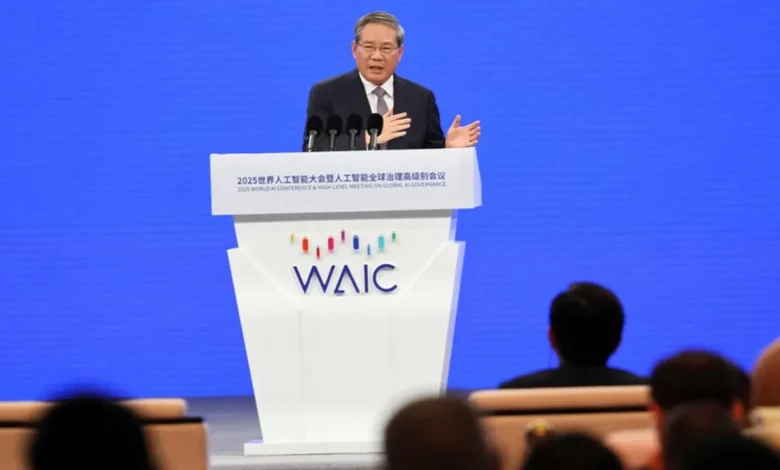
Speaking at the opening ceremony of the World Artificial Intelligence Conference (WAIC) in Shanghai, Li emphasized the importance of reaching a broad international consensus on AI development. He announced China’s plan to lead the formation of an international body for AI cooperation.
“The risks and challenges brought by artificial intelligence have drawn widespread attention. Finding a balance between development and security urgently requires broader societal consensus,” Li stated.
He highlighted open-source development, fair access to AI technology, and increased global sharing—especially with developing countries—as key to avoiding monopolization.
“If we pursue technological monopolies, restrictions, and blockades, AI will become the domain of a few nations and corporations,” Li warned. “Only through openness, sharing, and fairness can AI truly benefit all.”
Li also pointed to supply chain constraints, such as limited access to high-performance chips and computing power, as a major bottleneck for AI advancement. These comments came as the United States continues to restrict chip exports to China, citing concerns over military applications.
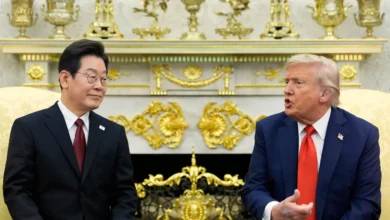
Meanwhile, President Donald Trump’s administration recently unveiled a low-regulation strategy focused on accelerating AI dominance by removing “red tape” that could slow private sector innovation. The US has also warned against “excessive regulation” in international forums.
At a February AI summit in Paris, 58 countries—including China, France, and India, as well as the EU and African Union—endorsed a declaration for an “open, inclusive, and ethical” AI framework. However, the United States and United Kingdom refused to sign, expressing concerns about regulatory overreach.
Also addressing WAIC, UN Secretary-General António Guterres called AI governance a “defining test of international cooperation.” France’s AI envoy Anne Bouverot echoed this, saying there is an “urgent need” for unified global action.
In a symbolic and sobering moment, Geoffrey Hinton, a Nobel Prize-winning physicist and AI pioneer, likened AI to “a very cute tiger cub”—warning that unless humanity learns to train it responsibly, it may pose existential risks as it matures.
China, which considers AI a cornerstone of its technological self-reliance strategy, is investing heavily in the sector. In January, Chinese startup DeepSeek unveiled an AI model comparable to leading US systems despite using less advanced chips, showcasing the country’s growing capabilities.