Turkish finance minister says eliminating PKK threat would unlock major economic benefits for the region

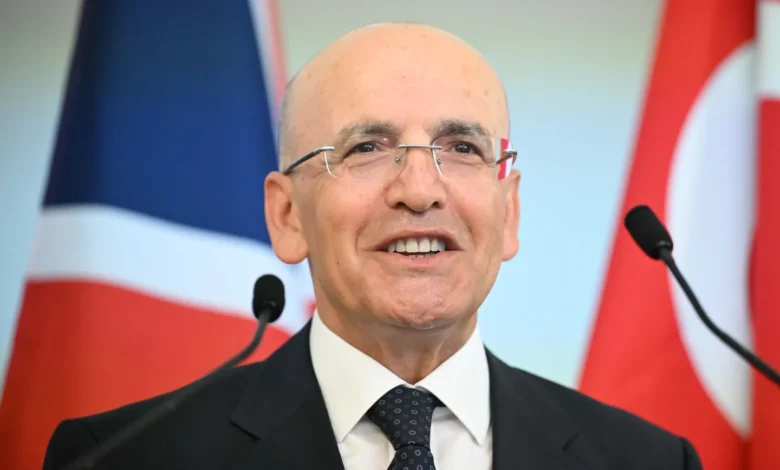
Disarming PKK will unlock vast economic potential, says Türkiye’s finance minister
Türkiye’s Treasury and Finance Minister Mehmet Simsek has said that the disarmament of the PKK will yield enormous economic benefits for the broader region, framing it as part of a wider geopolitical and economic shift. His remarks came during a high-profile trip to London, where he also detailed Türkiye’s Islamic finance roadmap and macroeconomic reform efforts.
Speaking at the UK-Türkiye Islamic Finance Forum on Tuesday, Simsek highlighted Ankara’s renewed pivot toward the West. “We’re effectively re-anchoring with the West. Even though the UK is no longer in the EU, we see it as a key partner alongside the US and EU,” he said, stressing that Türkiye is emerging from what he described as a “geopolitical recession” of the past decade.
Simsek underscored Türkiye’s unique role in mediating global conflicts, citing Ankara’s diplomatic engagements in issues ranging from the Russia-Ukraine war to the Armenia-Azerbaijan dispute and efforts to stabilize Syria.
PKK disarmament: economic promise and regional integration
In a significant statement, Simsek pointed to the disbanding and disarmament of the PKK, saying, “It’s happening.” He argued that putting an end to decades of terrorism would not only foster a more inclusive and democratic society but also unlock considerable economic opportunity.
“After nearly 50 years of PKK-led violence against Türkiye, this process opens the door to massive economic gains and deeper regional integration,” Simsek said. He noted that Türkiye’s eastern and southeastern provinces, where demographic trends are particularly strong, stand to become new drivers of growth.
“This is the story investors should watch,” he added.
Focus on economic fundamentals
During his London meetings, Simsek also updated investors on Türkiye’s macroeconomic trajectory. He acknowledged inflation remains the top challenge, though trends are improving.
“Inflation was at 72 percent last year. Now it’s at 35 percent — still high, but coming down. We expect it to reach single digits by 2027,” he said.
He also highlighted progress on the current account, noting that excluding gold and energy, Türkiye is in surplus. Despite the fiscal pressures from the devastating 2023 earthquakes, he affirmed Ankara’s commitment to sound public finances, with the debt-to-GDP ratio at about 25 percent.
Building on Islamic finance and UK-Türkiye cooperation
Simsek spotlighted Islamic finance as an area with major potential, describing it as structurally well-suited to managing risk and avoiding excessive speculation. “Relative to conventional finance, it’s more resilient, offering stability and liquidity through risk-sharing principles,” he explained.
While Islamic finance represents just 1 percent of global financial assets, its footprint in Türkiye is significantly larger — accounting for roughly 8 percent of banking, 12 percent of capital markets, and over 5 percent of insurance.
He also pointed to expanding collaboration opportunities between Türkiye and the UK. “Why not leverage our strengths together? British architects, Turkish contractors. Türkiye is the world’s second-largest overseas contractor after China,” he suggested.
Citing Türkiye’s dynamic services sector, which generated $115 billion in exports, and its fast-growing digital ecosystem — boasting over 850 gaming startups, second only to London — Simsek emphasized joint potential in areas like tourism, healthcare, and technology.