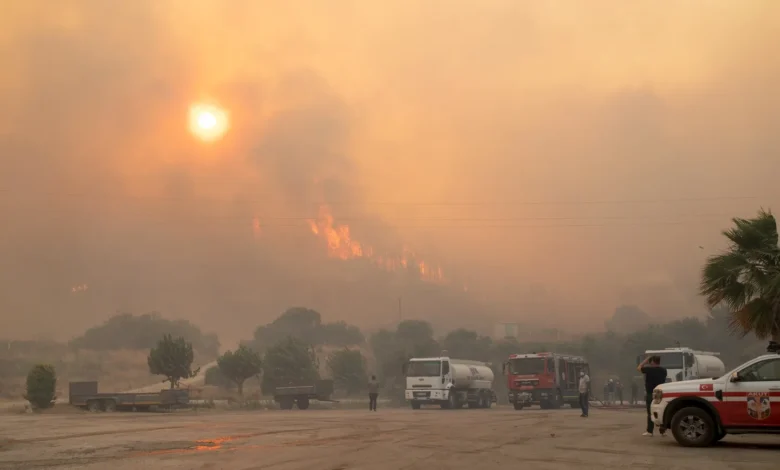
From discarded cigarette butts to malfunctioning power lines, explore how everyday oversights are driving the rise in wildfires across the globe.
This week, Turkish President Recep Tayyip Erdogan issued a stark warning about the rising threat of wildfires, both within Türkiye and around the world.
Speaking in Ankara at the “Green Homeland Heroes on Duty” gathering, Erdogan underscored humanity’s duty to prevent forest fires, pointing to how seemingly minor lapses can unleash massive destruction.
“Temperatures are rising, humidity is falling, and winds are stronger. Under these conditions, lighting a fire even in an open area near a forest is a disaster in the making. This is more than simple negligence. If it isn’t carelessness, then it’s outright betrayal,” Erdogan declared.
His words echo a global truth about the climate crisis: from Türkiye to California, Greece to Portugal, wildfires are increasingly sparked by small human errors that spiral into catastrophic blazes.
Common triggers: how tiny mistakes fuel massive fires
1. Carelessly discarded cigarette butts
Flicking a lit cigarette into dry grass is one of the simplest — and deadliest — ways to start a wildfire. In drought-prone places like California and parts of southern Europe, this careless act is behind countless outbreaks. According to the U.S. National Interagency Fire Center, human negligence drives a large share of all wildfire ignitions nationwide.
2. Unattended campfires and barbecue pits
Abandoned or poorly managed campfires remain a top cause of seasonal fires. The European Forest Fire Information System (EFFIS), which monitors blazes via satellites, notes that many summer fires across Europe trace back to leisure activities.
The U.S. National Park Service estimates around 85% of wildfires are linked to human behavior — from unextinguished campfires to tossed cigarettes. In Türkiye, analyses of wildfire causes list stubble burning, waste fires, hunting activities, and cigarette butts as leading factors, all pointing to negligence as a constant thread.
3. Burning garden or farm waste
Agricultural burns can quickly spin out of control. The U.S. Environmental Protection Agency warns that under dry, windy conditions, these fires can race across fields, sending smoke and flames into neighboring areas.
Likewise, the European Commission has highlighted how climate change makes Europe’s wildlands more flammable, demanding stricter caution when burning waste. Unchecked burning during risky weather dramatically raises the chances of a wildfire, particularly around the Mediterranean and the U.S. Midwest.
4. Equipment and vehicles
Chainsaws, lawnmowers, and hot car exhausts all pose ignition risks when used around dry vegetation. The U.S. Forest Service stresses the importance of regular maintenance and careful operation to prevent sparks. European officials also warn that in drought conditions, even a stray spark from a machine can ignite the landscape.
5. Fireworks and celebrations
Fireworks regularly set off fires across North America and Europe. The European Commission has even urged limiting pyrotechnics during periods of elevated fire danger.
In 2024, a notorious incident in Greece saw fireworks launched from a yacht start a forest fire on Hydra island, leading to 13 arrests. Outraged, the local mayor promised strong legal action, underscoring the serious consequences of such negligence.
In preparation for this year’s fire season, the EU has stationed more than 650 firefighters and aerial assets in France, Greece, Portugal, and Spain.
6. Illegal logging and poorly managed deforestation
Shoddy or illicit logging operations dry out forest floors and leave debris exposed to wind and sun. The UN Food and Agriculture Organization notes that land-use shifts tied to agriculture, tourism, and urban sprawl are increasing forest vulnerability in the Mediterranean.
Illegal logging, overgrazing, and unchecked coastal development strip natural protections, making fires more likely. The solution, experts say, lies in integrated strategies that adapt forests to a changing climate — involving agriculture, urban planning, water management, education, and tourism policies.
7. Power-line failures
Downed or faulty power lines have triggered some of the most devastating wildfires on record.
The California Public Utilities Commission reports that while utility infrastructure causes fewer than 10% of all reported fires, these incidents account for roughly half of the state’s most destructive blazes.
The 2018 Camp Fire, California’s deadliest, started when a PG&E power line failed during high winds. Similarly, the 2022 Edgewood Fire was traced to inadequate spacing in electrical circuits — a problem flagged years earlier but left uncorrected, resulting in PG&E being fined $7 million for safety violations.
Why it matters
Erdogan’s remarks serve as a critical reminder: nearly all forest fires are rooted in human activity.
The European Commission estimates that 96% of wildfires on the continent are caused by people. These fires devastate ecosystems, worsen air quality, and destroy homes and communities.
What’s unfolding across California, Türkiye, Greece, and beyond is largely preventable. Tackling it requires not only stronger policies and infrastructure, but also a deeper sense of shared responsibility — recognizing that the smallest missteps can unleash some of the world’s fiercest disasters.